THE STONE
What Hematite Actually Is: The Stone Behind the Band, Explained.

If you have spent any time in the wellness corner of the internet you have probably seen hematite described in language that strays into the magical. Energy stone. Grounding crystal. Magnetic healing bracelet. The marketing language has run a long way ahead of the material, and the material is honest enough on its own that it does not need any of that. Hematite is iron oxide. It is one of the most common, most studied, and most useful minerals on Earth. This article is a clean breakdown of what it is, where it comes from, and why the weight of a Hematite Band on your wrist is exactly what it appears to be: real iron-bearing stone, polished and strung on a cord. No mysticism required.
The chemistry, plainly
Hematite is the mineral name for one specific form of iron oxide. Its chemical formula is Fe2O3, which is two atoms of iron bonded to three atoms of oxygen, arranged in a hexagonal crystal lattice. By weight, it is roughly seventy percent iron and thirty percent oxygen.
That iron content is the reason hematite is heavy. Pure iron has a density of about 7.9 grams per cubic centimetre, more than twice the density of typical surface rock. Hematite, being mostly iron with a smaller fraction of oxygen, sits around 5.3 grams per cubic centimetre. For comparison, the obsidian-looking stones often passed off as hematite in low-end jewellery are typically glass or plastic and weigh around 2.5 grams per cubic centimetre. If you have ever held a real hematite bead and felt how much it weighs for its size, that is iron content speaking.
Where the name comes from
Hematite gets its name from the Greek word haima, meaning blood. The name was given in antiquity not because the stone looks bloody (a polished hematite is black, often with a slight cool grey or steel sheen) but because of the streak test. Every mineral has a characteristic colour it leaves behind when scratched against a rougher surface, regardless of the colour of the polished stone itself. Hematite's streak is dark red, the colour of dried blood. Take a piece of finished hematite, drag it firmly across an unglazed ceramic plate, and the streak that comes off will be unmistakably red. That is the iron oxide showing its true colour at the powder level.
The red streak is why the Greeks named it haematites. The Romans used the same word. Medieval European mineralogists called it bloodstone for a while, which is now confusingly the name of a different stone (heliotrope) entirely. Modern mineralogy settled on hematite as the standard English name in the nineteenth century.
How it forms
Hematite forms in several geological environments. The largest commercial deposits in the world (the banded iron formations of Western Australia, Brazil, and the Canadian Shield) formed roughly two billion years ago, during a period in Earth's history when oxygen produced by early photosynthetic bacteria reacted with dissolved iron in the world's oceans and precipitated out as iron oxide on the sea floor. Those deposits are now buried, mined, and shipped as the raw material for nearly all global iron and steel production.
Hematite also forms in much smaller, more accessible settings. It forms in volcanic hot springs, in the oxidised cap above many mineral veins, and in the iron-rich groundwater that seeps through peat bogs. The bog iron the Vikings smelted (covered in detail in our history article) is mostly hematite, with some limonite and goethite mixed in. So is the iron ore mined today in Sweden, Brazil, Australia, China, and Russia.
The hematite used in jewellery is sourced from the same kinds of mines that produce industrial iron ore. The grade that ends up in beads is selected for its visual qualities: a clean dark steel-black surface with a slight metallic sheen, free of weathering or visible inclusions. The lower-grade ore continues on to the steel mill.
Polished hematite versus "magnetic hematite"
This is the part of the conversation where most internet sources go off the rails, so we will be precise. There are essentially three different materials sold as hematite bracelets, and they are not the same thing.
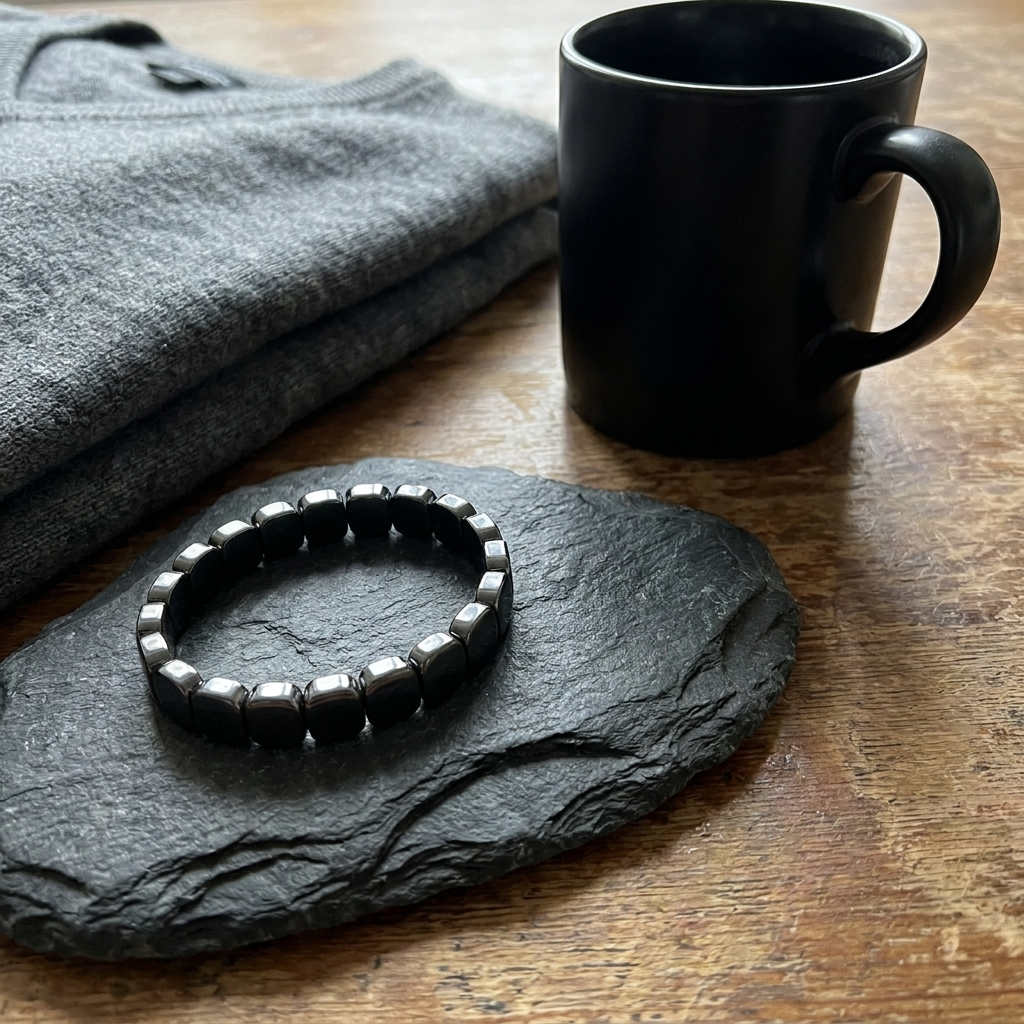
Real polished hematite. This is natural Fe2O3, cut from rough hematite ore and tumbled or faceted into beads. It has a dark steel-black colour with a slight cool sheen. It produces a red streak. It is mildly weakly diamagnetic, which means it has no detectable magnetic pull at room temperature. A real polished hematite bead will not stick to a fridge magnet. The Hematite Band is made from real polished hematite.
Hematine (also called hemalyke, hemalike, magnetic hematite). This is a synthetic material developed in the mid twentieth century specifically for novelty jewellery. It looks visually similar to polished hematite but is manufactured by sintering iron oxide powder with barium and strontium ferrite to make a material that is strongly magnetic. When you see "magnetic hematite" jewellery being sold with wellness claims, this is almost always what is actually in the bracelet. It is not natural hematite. It is a synthetic ceramic.
Plated steel or coated plastic. The lowest-end "hematite" bracelets are mass-produced from steel or plastic beads coated with a thin metallic finish. The finish strips within weeks of wear. The stone underneath is not hematite at all. This is the category of cheap wellness bracelet that the comparison row on the product page is contrasting with.
The reason this matters is that the three categories behave completely differently. Real polished hematite has no magnetic field to speak of, so any health claim built on magnetism is talking about hematine, not hematite. Hematine, in turn, is not really hematite, so any heritage claim built on Norse iron history does not apply to it. The Hematite Band sidesteps both problems by being made from the real material with no health or magnetic claim attached. The case for wearing one is heritage and material, not magnetism or wellness.
The physical properties
For the technically inclined, here are the standard measured properties of natural polished hematite. These are the numbers that determine how it feels on the wrist.
- Density: 5.26 grams per cubic centimetre. Roughly twice the weight of an equivalent volume of glass or plastic.
- Hardness: 5.5 to 6.5 on the Mohs scale. Hard enough that the polished surface resists scratches from everyday wear (keys, watch buckles, coins) but slightly softer than quartz. Use a soft cloth to wipe it; do not scrub with abrasives.
- Streak: dark red. As described above.
- Lustre: metallic, sub-metallic on weathered surfaces. The polished face has a distinct cool steel sheen, particularly under natural daylight.
- Magnetism: weakly diamagnetic, no functional magnetic field at room temperature.
- Heat capacity: moderate. The stone warms to body temperature within a few minutes of being worn and stays there, which is part of why it does not feel cold against the skin after the first minute.
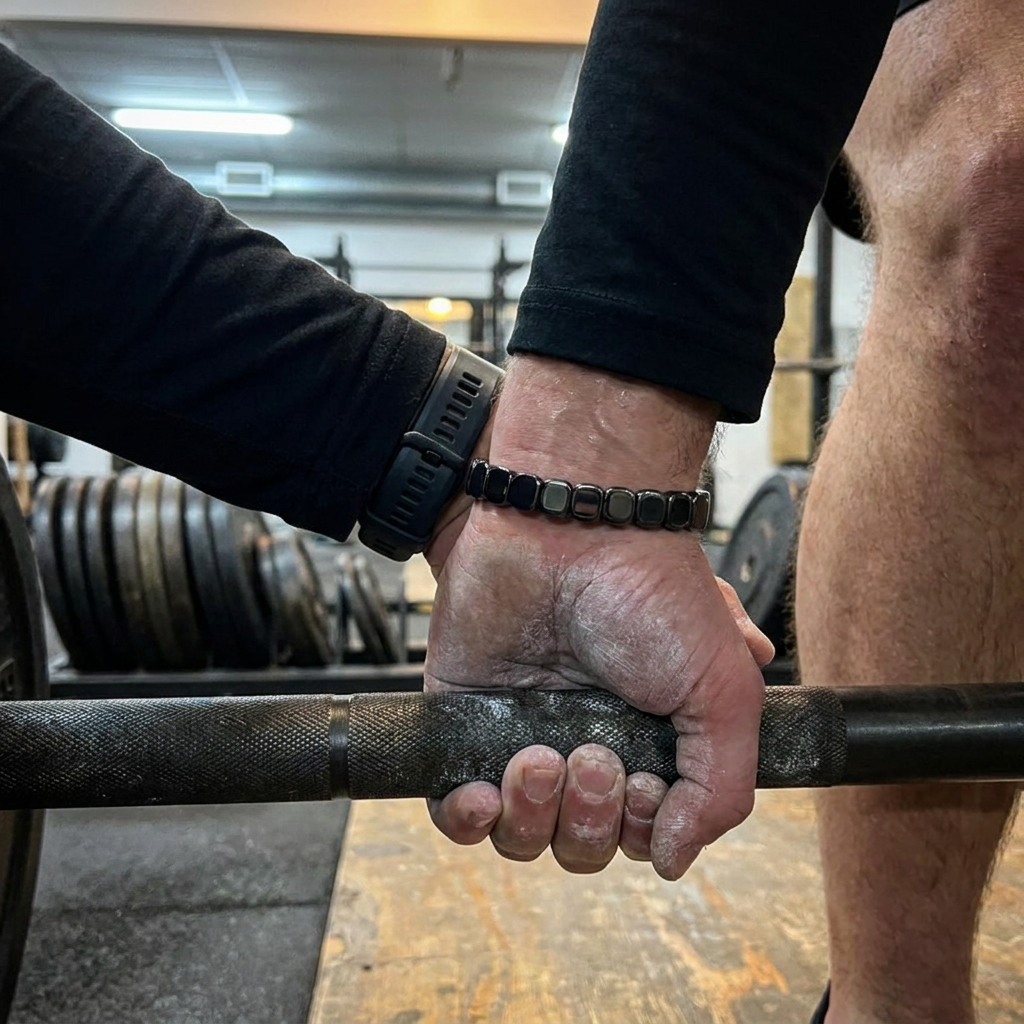
- Reaction to moisture: none. Hematite does not absorb water and does not corrode in air or water at ambient temperature. You can shower with it. You can train with it. The cord is the wear part; the stone is essentially permanent.
Why the beads are faceted, not round
Hematite has been cut into round beads for centuries (Egyptian, Roman, Norse, and Native American grave finds all include round hematite beads), but the modern preference for men's jewellery is for faceted, low-profile beads that sit closer to the wrist. The Hematite Band uses rectangular faceted beads for two reasons.
First, the rectangular facets sit flat against the skin so the band has a low profile under a shirt cuff. A high-domed round bead pushes a cuff out visibly; a faceted bead does not.
Second, faceted beads catch light in a way that emphasises the steel-grey sheen of the polished material. A round bead lit from above produces a single highlight; a faceted bead produces a row of small highlights along the wrist. Visually, this reads as deliberate jewellery rather than a string of generic round stones.
How to tell if hematite is real
Three quick tests, in order of effort:
- Weight. Pick the band up. A real polished hematite band of the size we sell weighs noticeably more than a comparable string of glass or plastic beads. If it feels light for its size, it is probably not real hematite.
- Streak. If you can spare one bead, drag it across an unglazed white ceramic surface (the bottom of a coffee mug works). Real hematite leaves a dark red streak. Hematine, plated steel, and coated plastic will not leave the red streak.
- Magnetism. Hold a strong fridge magnet against the band. Real hematite will not stick. Hematine ("magnetic hematite") will. Plated steel may, depending on the base metal.
If you have a Hematite Band on your wrist and you want to confirm what it is, the streak test is definitive. The result will be the dark red of the iron oxide.
The case for real material
Real polished hematite has no health claim and makes no promise about your energy levels, sleep, or anything else. What it offers is a material that is what it claims to be: solid iron-bearing stone, the same Fe2O3 the Vikings smelted into iron, polished and worn on the wrist. The weight is real because the iron content is real. The longevity is real because the stone does not tarnish, fade, or wear in a way the cord cannot replace. The heritage is real because the material is identical to what was used a thousand years ago.
That is the whole pitch. No magnetic field, no chakra alignment, no marketing-grade mysticism. A solid stone on a black cord, real to the gram, on the wrist of a man who knows what he is wearing.
See the Hematite Band stacks to start.