HISTORY
The Viking's Iron: A 1,000-Year History of the Stone on Your Wrist.

Before steel, before the watchmakers of Switzerland, before the wristwatch existed as a category, men wore iron on their wrist. They wore it because they had made it themselves out of a stone pulled from a bog, and because that stone meant something. The stone was hematite, the same mineral that sits on your wrist when you wear a Hematite Band today. The men who first refined it into iron were Norse, and the civilisation they built around that iron rewrote the map of medieval Europe.
This is the long history of how a black stone with a red streak became the iron that built longships, axes, ploughs, and a Viking world that lasted nearly four centuries. It is also the case for why the same stone, polished and worn, still carries weight.
The mineral and the metal
Hematite is iron oxide, chemical formula Fe2O3. It is one of the most common minerals on the planet's crust and the world's single largest source of iron metal. It forms in a dozen geological environments, from deep volcanic veins to sedimentary beds laid down on the floor of ancient lakes, but the form the Vikings found most accessible came from a much humbler source: peat bogs.
Bog iron forms when iron-rich groundwater seeps through anaerobic peat soils and bacteria precipitate the iron out as a thick, rust-coloured sludge that hardens into nodules over time. These nodules are mostly hematite (with some limonite, a related iron oxide). They grow continuously, which means a single bog can be harvested every twenty to thirty years, then left to regenerate. Scandinavia, with its peat bogs running from southern Denmark to northern Norway, was geologically lucky.
The Norse word for iron, jarn, is the root of the modern English word. The Norse word for the bog where they found it was myr, the root of the modern English mire. The two words travelled together into half the languages of northern Europe.
The Norse smith
Around the seventh century AD, Scandinavian communities figured out how to smelt bog iron at scale. The process was not trivial. You needed a clay furnace, a steady source of charcoal, several days of continuous firing, and a smith with the skill to read the slag and time the reduction. What came out of the furnace was a porous bloom of low-carbon iron, which then had to be hammered repeatedly to drive out the slag inclusions and consolidate the metal.
The smiths who did this work were not labourers. In Norse society they were a privileged class, sometimes named in the sagas, sometimes attributed quasi-magical powers. The most famous of them, Volund the Smith, is a legendary figure across northern Europe, the Norse equivalent of the Greek Hephaestus or the Roman Vulcan. He appears in the Poetic Edda, the Anglo-Saxon Deor, and dozens of carved stone images across Scandinavia and Britain. He is shown working iron, taking revenge on a king who imprisoned him, and finally escaping by forging wings. The story is older than the Vikings and survives in carved form on the Franks Casket, a whalebone box from the eighth century now in the British Museum.
The point of the Volund cycle, like the Hephaestus cycle in Greek myth, is that the smith is not just a craftsman. He is the man who turns stone into the tools that determine who wins and who loses. In a world where the difference between a longship raid and a defended village was the quality of the iron in the axe head, that mattered.
What they built with it
The Norse iron industry between roughly 750 and 1100 AD produced an output that historians still find hard to credit. From bog hematite they made:
- Longship rivets. A single ocean-going longship needed several thousand iron rivets to hold its overlapping oak planks. The ships were mass-produced. Surviving Viking longships in Roskilde, Denmark, have rivet counts ranging from 2,000 to over 6,000.
- Axes, swords, spears, knives. The Ulfberht swords, signed with a maker's mark on the blade, are the most famous Viking weapons. Modern metallurgical analysis of surviving Ulfberhts shows a carbon content and crucible-steel technique centuries ahead of contemporary European production. Some scholars believe Ulfberht steel was traded in from the Eurasian steppe; others believe it was developed independently by Norse smiths. The debate is unresolved, but the swords are real and they survived.
- Agricultural tools. Iron ploughs, scythes, sickles, billhooks, harrow teeth. The Viking expansion was as much an agricultural expansion as a military one, and iron tools made it possible to clear and till land that wooden tools could not work.
- Tools of the smith and the carpenter. Hammers, chisels, adzes, saws, files. The toolkit of the men who built the longships was itself made of bog iron.
- Personal items. Brooches, buckles, keys, locks, riding bits, horseshoes. Iron entered every part of daily Norse life.
And, importantly for our purposes here, they made jewellery. Polished hematite beads have been recovered from Viking-age graves in Birka (Sweden), Hedeby (Denmark), and York (England). The beads were strung as pendants, sewn onto cloth, and worn on the wrist. The Norse word for them, jarnsteinn, literally means iron-stone.
The trade routes
The Vikings did not keep all their iron at home. By the late ninth century Norse iron was the dominant export of Scandinavia, traded south across the Baltic, west into Britain and Ireland, and east along the river routes that ran through Kievan Rus down to Constantinople and the Caspian. A Viking trade hub like Hedeby had a working harbour, a network of smiths, and a permanent iron market.
The Arabic geographer Ibn Fadlan, who travelled through Rus in the early tenth century and met Viking traders on the Volga, described their goods in detail. Iron was at the top of the list. By his account, a Viking trader could turn a winter's smelting in a Swedish bog into a full season's profit in a Persian market.
The wealth that came back funded the next round of ships, the next round of smelting, the next round of expansion. It is not an exaggeration to say that bog hematite, smelted into iron by Norse smiths, financed the Viking world.
Hematite as charm and amulet
Iron was also a protective material in Norse belief. Cold iron, in folklore across northern Europe, was held to repel evil and ward off the otherworld. Newborn children had a small piece of iron placed on the cradle. Brides carried iron into the marriage hall. Burial mounds were furnished with iron grave goods, partly because the dead needed their tools and weapons in the afterlife, partly because the iron itself was protective.
Polished hematite beads occupied a specific place in this tradition. They were the visual, wearable form of the same iron the smith was working in his forge: black, weighted, with a faint red streak when scratched. The red streak gave the stone its name, from the Greek haima, meaning blood. To wear a hematite bead on the wrist was, in Norse logic, to wear a piece of the smith's furnace.
A man who wore hematite at his wrist was wearing a stone that had been pulled from the same bog as the iron in his axe, the rivets in his longship, and the cloak pin at his throat. It was a quiet daily reminder of where his world came from.
What survived
The Viking age formally ended in 1066, but the iron tradition did not. Norse smiths trained the smiths of medieval Scandinavia, who in turn trained the early modern smiths of Sweden and Norway. The Swedish iron industry, which became the foundation of one of the most stable economies in Europe by the seventeenth century, traces a direct lineage back to the bog-iron smelters of the eighth century. The stone was the same. The technique evolved.
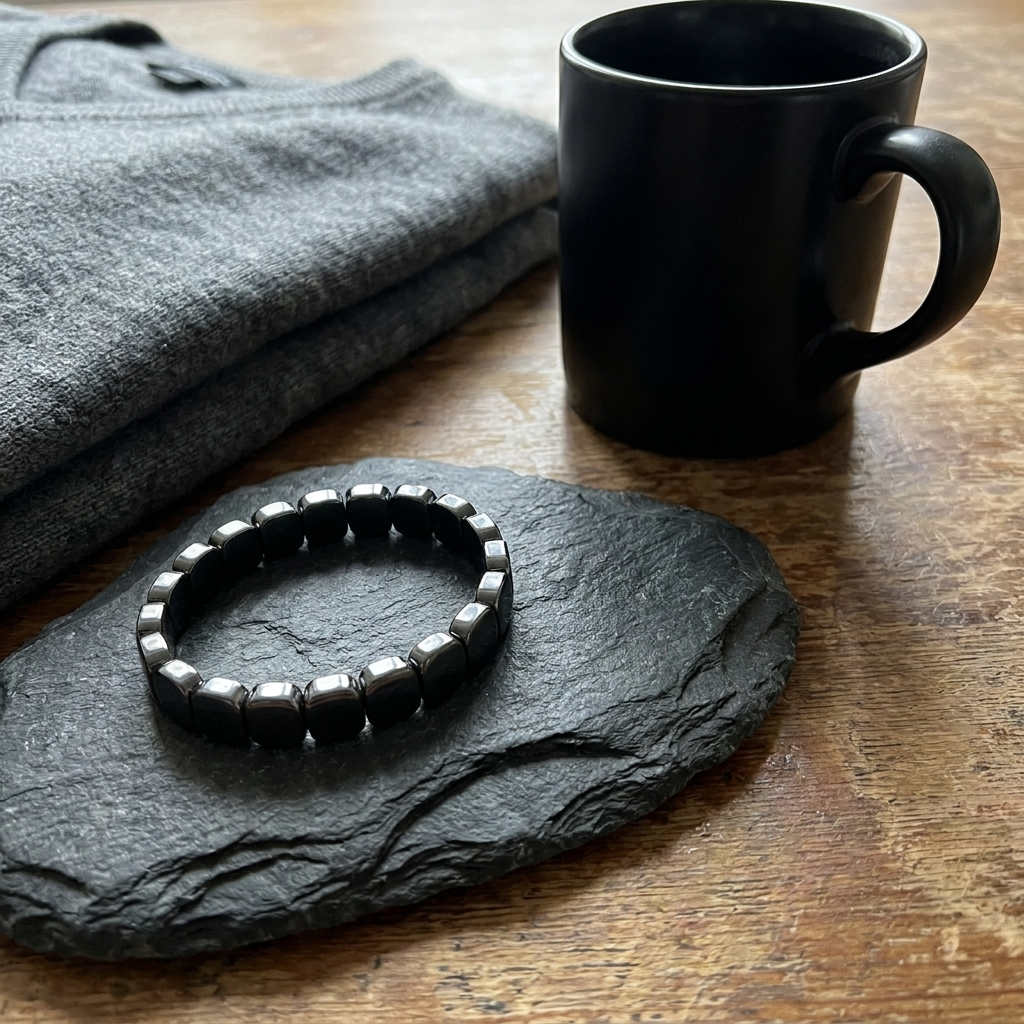
The Hematite Band sits at the polished end of that same thousand-year story. The beads in your wrist are the same Fe2O3 that the Norse smith fed into his furnace, but instead of being reduced to elemental iron and forged into an axe, they have been cut, tumbled, and faceted into a wearable form. The material is identical. The meaning the Vikings gave it, the everyday weight of carrying iron on the wrist, is intact.
Why this matters now
You can wear plated copper. You can wear plastic. You can wear nothing. Or you can wear a piece of the same stone that built the longships, the swords, the trade routes, and the silver-counted wealth of an entire civilisation. The choice is a small one in the day-to-day sense. It costs you one slip-on action in the morning. But the cumulative weight of carrying a heritage object is what made the Norse smiths' work matter in the first place. They were not making tools. They were making the daily, repeated proof that iron was the material the world ran on.
The Hematite Band is the modern, polished, low-key version of that. No costume. No claim to be a Viking. Just a piece of the stone the Vikings would have recognised, on the wrist of a man who has thought about what he is carrying.
See the Hematite Band stacks to start.